Mathieu Meijers (1951, the Netherlands)
“I don’t see anything, I only paint thoughts,” says Mathieu Meijers. And the most fundamental of these thoughts concern representation, perception and painting itself. Reduced to its essence, Meijers’ work is about the light that makes all this possible.
Meijers grew up in Eindhoven as the eldest son of a miner. His father worked 800 metres underground, spending half his life in darkness. One of his brothers studies photons at CERN, the European Organisation for Nuclear Research. The other is a talented amateur photographer who spends much of his time in the darkroom.
As an artist concerned with light—a phenomenon that is inherently historical, since the rays we perceive have been travelling for millions of years—Meijers does not operate solely in the here and now of reality. Instead, his intention is to create a new reality, a material one.
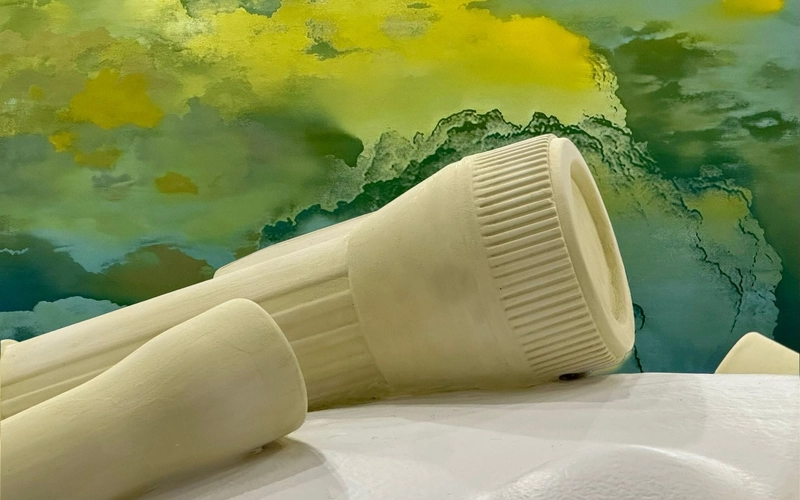
To achieve this, he draws from the repository of images that feels most authentic to him: his own memories. Motifs from his youth include pears, cargo ships, and a Volkswagen Beetle, but also the abstract form of a window frame. By repeating these motifs again and again, they become unique archetypes—symbols loaded with historical and associative meaning yet remaining the concrete things they are. Through the act of painting, with each repetition, new layers of meaning continuously unfold.
In 2002, Meijers abruptly decided to stop painting. He shifted to drawing, a much faster and more direct form of expression. His drawings developed into series with a narrative streak and are sometimes collected in books. Gradually, Meijers began adding colour to his drawings and painting found its way back into his work. In 2016, he began devising colour schemes in which he felt freer than in the autobiographically informed narrative, schemes that challenge—and perhaps even transcend—the boundaries of painting.
Like a simultaneous chess player, Meijers works on several series at once. He repeats themes and motifs to the point of exhaustion. He jumps back and forth in time, making his artistic evolution appear spiral-like: to move forward, he sometimes takes a few steps back first. In this way, he slowly moves closer to the point where form and content, paint and concept, finally converge.

Artworks